Choosing an espresso machine with flow control gives you more control over pressure, extraction, and flavor than a basic pump machine. The right model can help you refine light roasts, improve consistency, and build café-style drinks at home.
This roundup compares 10 machines across manual control, temperature stability, steaming performance, workflow, and overall value, including capable alternatives for beginners and convenience-focused buyers.
Best 10 Espresso Machine with Flow Control Picks for 2026
Best Overall Control
Diletta Alto Flow Control (Black)

- Manual flow valve supports advanced shot profiling
- Dual boilers with PID temperature control
- Includes bottomless and standard portafilters
Best For: Home baristas refining extraction with hands-on control
Best for Guided Brewing

- Heats in under two minutes
- Guided recipes and built-in shot feedback
- Pressure profiling with controlled flow
Best For: Beginners who want assistance without giving up control
Best Stainless Steel Finish

- Manual flow adjustment with pressure gauge
- Dual boilers and PID temperature management
- Stainless-steel body with 3-liter capacity
Best For: Control-focused users who prefer a stainless-steel machine
Best Compact Traditional Design

- Heat exchanger supports brewing and steaming together
- Compact 17-inch depth
- Manual controls and copper finish
Best For: Users prioritizing compact Italian design over dedicated flow profiling
Best Manual Control Pick
- Programmable passive preinfusion up to 10 seconds
- PID display also works as a shot timer
- Dual boiler with all-manual controls
Best For: Hands-on home baristas who want adjustable extraction variables
Best for Guided Convenience

- Low-pressure pre-infusion for balanced extraction
- Integrated conical burr grinder
- Touchscreen saves up to eight custom coffees
Best For: Users seeking customizable drinks with automated guidance
Best Compact Entry-Level Option

- 15-bar pump and built-in pressure gauge
- Customizable single and double presets
- Compact design with adjustable milk frother
Best For: Beginners wanting simple espresso preparation in a smaller kitchen
Fast-Heating Home Barista Pick
- Low-pressure pre-infusion supports balanced extraction
- Built-in grinder and guided LCD workflow
- ThermoJet heating reaches temperature in about 3 seconds
Best For: Home users wanting quick, guided espresso preparation with milk-drink capability
Pressure-Tuning Upgrade

- Dual boilers separate brewing and steaming
- Adjustable OPV enables brew-pressure customization
- PID controls and shot timer support precise dialing in
Best For: Experienced users prioritizing temperature stability and pressure adjustment
Proven Grinder-included Value

- Integrated burr grinder doses directly into the portafilter
- Low-pressure pre-infusion and PID temperature control
- Manual override and grind-size dial support customization
Best For: Newer home baristas seeking an all-in-one manual espresso setup
Best Overall Control – Diletta Alto Flow Control (Black)
The Diletta Alto is a strong choice if you want an espresso machine with flow control plus the temperature stability of a dual-boiler design. Its adjustable flow valve, PID controls, pressure gauge, and shot timer give experienced home baristas several ways to refine extraction.
Best For: Home baristas who want manual flow profiling, separate brew and steam boilers, and a black Milan-built machine.
Pros:
- Manual flow control supports declining-flow and turbo-shot techniques.
- Dual boilers and PID controls help manage brew and steam temperatures independently.
- Includes bottomless and standard portafilters, plus double and triple baskets.
- Shot timer is integrated into the front-mounted PID display.
Cons:
- 22-minute brew warm-up is slower than rapid-heating alternatives.
- At 40 pounds and nearly 20 inches deep, it needs substantial counter space.
The Alto is aimed at control-focused users rather than those seeking a simple push-button workflow. Its flow-control hardware and dual-boiler platform make it particularly suitable for experimenting with different extraction styles.
Best for Guided Brewing – Fellow Espresso Series 1
The Fellow Espresso Series 1 combines an espresso machine with flow control and pressure profiling with a more guided user experience. On-screen recipes, shot feedback, temperature control, and a fast heat-up time make it approachable for beginners while leaving room for dialing in technique.
Best For: Newer espresso users who want guided brewing, quick startup, and adjustable pressure and flow as their skills develop.
Pros:
- Heats in under two minutes for a faster start to brewing.
- On-screen guidance and shot feedback help identify shots that run too fast or slow.
- Pressure profiling and controlled flow provide room for recipe experimentation.
- Temperature-sensing steam wand automatically stops at the selected milk temperature.
Cons:
- Its 23.07-inch depth may be challenging for shallow counters.
- It has a smaller 2-liter capacity than the Diletta Alto.
This is a practical bridge between convenience and hands-on espresso preparation. It offers useful assistance without removing the ability to adjust pressure, flow, and temperature as you gain experience.
Best Stainless Steel Finish – Diletta Alto Flow Control
The stainless-steel Diletta Alto delivers the same flow-control-focused platform as its black counterpart. It pairs manual flow adjustment with dual boilers, PID temperature management, an integrated shot timer, and a 3-liter capacity for users who want detailed control over espresso preparation.
Best For: Experienced home baristas who prefer a stainless-steel finish and want dual-boiler performance with manual flow adjustment.
Pros:
- Built-in flow valve and pressure gauge let you adjust water delivery to the puck.
- Separate brew and steam boilers support simultaneous espresso and milk preparation.
- Front-mounted PID controls manage brew and steam temperatures.
- Includes a bottomless portafilter, double portafilter, and multiple baskets.
Cons:
- Requires about 22 minutes to reach brew temperature.
- The 40-pound body and 19.75-inch depth make it better suited to a dedicated setup.
If you value traditional, hands-on workflow and a polished stainless-steel exterior, this Alto configuration is a capable match. It offers extensive control, but its warm-up time and footprint should be considered before purchase.
Best Compact Traditional Design – Rocket Appartamento 2.0
Rocket Espresso Appartamento 2.0 Espresso Machine | Heat Exchanger | 1.8L | (Copper)
Check Price On AmazonThe Rocket Appartamento 2.0 is a compact, manually operated alternative for shoppers considering an espresso machine with flow control. While the supplied features emphasize mechanical brew controls rather than a dedicated flow-control valve, its heat-exchanger system, heated group head, and manual workflow support hands-on espresso preparation.
Best For: Users who want a compact Italian machine with manual controls, simultaneous brewing and steaming, and a distinctive copper finish.
Pros:
- Heat-exchanger boiler allows brewing espresso and steaming milk at the same time.
- Compact 17-inch depth suits space-restricted kitchens.
- Manual brew, steam, and hot-water controls encourage hands-on preparation.
- Updated design includes a deeper drip tray and longer steam and hot-water valves.
Cons:
- Does not list a dedicated flow-control valve or PID system.
- Manual operation offers less guided assistance for beginners.
- Its 50-pound weight is substantial for a compact machine.
The Appartamento 2.0 is best viewed as a traditional manual machine rather than a dedicated flow-profiling model. Choose it for its compact footprint, simultaneous brewing and steaming, and classic Rocket design—not for specialized flow-control hardware.
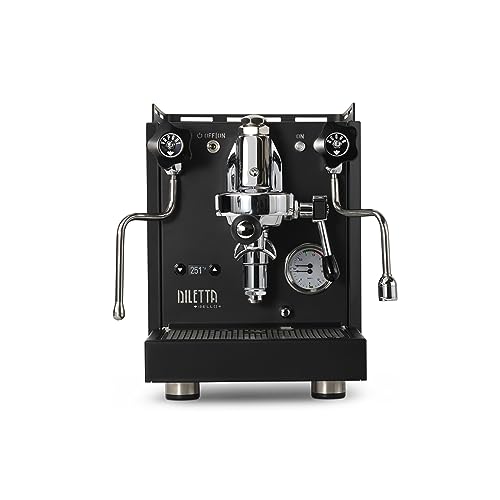
Best Manual Control Pick – Diletta Bello+
If you want an espresso machine with flow control potential and hands-on brewing, the Diletta Bello+ is a strong fit. Its E61 design, programmable passive preinfusion, PID temperature control, and manual brew controls give experienced home baristas useful control over extraction variables.
Best For: Home baristas who prioritize manual control, temperature management, and repeatable espresso preparation.
Pros:
- Programmable passive preinfusion up to 10 seconds
- Front-mounted PID doubles as a shot timer
- Stainless-steel case, frame, and boiler
- Dual-boiler design with manual brew and steam controls
Cons:
- Does not include an integrated grinder
- Manual operation requires more barista involvement
- Its 17.75-inch depth may require substantial counter space
The Bello+ is best suited to users who want to actively refine their shots rather than rely on one-touch automation. Its programmable preinfusion supports flow-focused experimentation, while the PID and shot timer help make adjustments easier to evaluate.
Best for Guided Convenience – Breville Barista Touch
The Breville Barista Touch is a convenient alternative for shoppers comparing an espresso machine with flow control features alongside automated assistance. Its low-pressure pre-infusion, PID temperature regulation, integrated grinder, and touchscreen workflow simplify the path from whole beans to espresso-based drinks.
Best For: Households that want customizable espresso and milk drinks with an integrated grinder and guided touchscreen controls.
Pros:
- Low-pressure pre-infusion gradually increases extraction pressure
- PID provides digital temperature regulation
- Built-in conical burr grinder doses coffee on demand
- Save up to eight personalized coffees
Cons:
- More automated than a fully manual flow-control setup
- Integrated grinder and touchscreen add system complexity
- Milk steaming and recipe customization depend on electronic controls
Although it is not presented as a dedicated manual flow-profiling machine, the Barista Touch offers useful control through pre-infusion, temperature, grind, dose, and milk settings. It is a practical choice when repeatability and speed matter as much as hands-on experimentation.
Best Compact Entry-Level Option – De'Longhi Classic Signature
The De’Longhi Classic Signature is a compact, straightforward option for shoppers exploring an espresso machine with flow control without needing advanced manual profiling. Its 15-bar pump, preset single and double recipes, pressure gauge, and adjustable milk frother cover the basics for everyday espresso drinks.
Best For: Beginners and compact-kitchen users who want simple preset brewing with manual frothing capability.
Pros:
- Includes a pressure gauge for monitoring brewing pressure
- Preset single and double espresso recipes are customizable
- Thermoblock technology provides fast, stable temperature control
- Compact stainless-steel design with a steam wand
Cons:
- Does not offer programmable flow profiling or pre-infusion controls
- Uses ground coffee rather than whole-bean grinding
- One-year warranty is shorter than some competing options
The Classic Signature is better viewed as an accessible espresso machine with basic brewing feedback than as a true flow-control platform. Its pressure gauge and adjustable frother add useful involvement, but users seeking detailed extraction profiling should consider a more advanced machine.
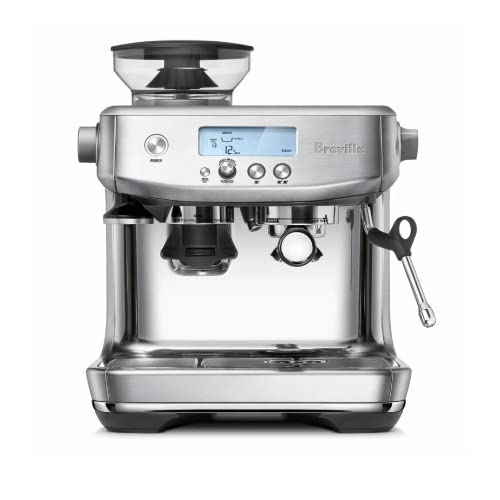
Fast-Heating Home Barista Pick – Breville Barista Pro
The Breville Barista Pro is a practical espresso machine with flow control-inspired features for home users who want repeatable extraction. Its low-pressure pre-infusion, PID temperature regulation, built-in grinder, and guided LCD interface help simplify the path from whole beans to espresso.
Best For: Home baristas who want an integrated grinder, quick heat-up, and guided controls for espresso and milk drinks.
Pros:
- Low-pressure pre-infusion gradually increases pressure for more even extraction.
- ThermoJet heating reaches extraction temperature in about 3 seconds and transitions quickly to steam.
- Built-in conical burr grinder, adjustable grinding, and LCD progress guidance streamline preparation.
- Powerful steam wand supports smooth microfoam and latte art.
Cons:
- It does not provide a user-adjustable flow-control valve or manual flow-rate adjustment.
- The manual workflow requires dialing in grind, dosing, tamping, and milk texture.
- Its 2-year warranty is limited.
The Barista Pro emphasizes speed and convenience rather than advanced manual flow profiling. It is a strong fit if you want pre-infusion and temperature control with an integrated grinder, but dedicated enthusiasts seeking direct flow adjustment may prefer a more specialized machine.
Pressure-Tuning Upgrade – Diletta Alto Dual Boiler
Diletta Alto Espresso Machine | Dual Boiler | PID | Shot Timer | Adjustable OPV | (Stainless Steel)
Check Price On AmazonThe Diletta Alto is a dual-boiler espresso machine with PID control, a shot timer, and an accessible adjustable OPV. For shoppers comparing an espresso machine with flow control, the OPV offers brew-pressure customization, although this model is listed as being without flow control and does not provide a direct flow-control system.
Best For: Experienced home baristas who value dual-boiler temperature management, pressure tuning, and traditional manual preparation.
Pros:
- Separate brew and steam boilers support independent temperature management.
- Front-mounted PID controls provide to-the-degree brew and steam temperature adjustment.
- Accessible adjustable OPV lets users customize brew pressure without deep disassembly.
- Shot timer, 58mm portafilter, bottomless portafilter, and pro-style accessories support dialing in.
Cons:
- The product is specifically identified as “Without Flow Control,” so it is not a true flow-profiling machine.
- Approximately 22 minutes of brew warm-up time is relatively long.
- At 40 pounds, it is heavy and requires substantial counter space.
The Alto is better understood as a pressure-tuning machine than a flow-control machine. Its dual boilers and adjustable OPV make it appealing for users who understand espresso variables, but shoppers specifically seeking manual flow manipulation should verify that capability before buying.
Proven Grinder-included Value – Breville Barista Express
The Breville Barista Express is a manual all-in-one espresso machine that combines a conical burr grinder with low-pressure pre-infusion and PID temperature regulation. It is not a dedicated espresso machine with flow control, but its manual override and adjustable grind settings give home users useful control over preparation.
Best For: Beginners and intermediate home baristas who want an established bean-to-cup setup for espresso, lattes, and cappuccinos.
Pros:
- Integrated grinder doses freshly ground coffee directly into the portafilter.
- Low-pressure pre-infusion helps draw out flavors evenly during extraction.
- PID temperature regulation supports consistent brewing temperature.
- Manual override, grind-size adjustment, and included trimming and tamping tools encourage customization.
Cons:
- It lacks a dedicated adjustable flow-control mechanism.
- The 1-year limited warranty is shorter than the Barista Pro’s listed warranty.
- Manual grinding, dosing, tamping, extraction, and milk steaming require practice.
The Barista Express offers a capable entry point for hands-on espresso without adding a separate grinder. Choose it for value and an approachable manual workflow; choose a true flow-control machine if changing water flow throughout the shot is a priority.
How We Picked the Best Espresso Machine with Flow Control
We evaluated these machines based on the control they provide during brewing, temperature management, pressure adjustment, usability, and milk-steaming capability. We also considered whether each model suits an experienced home barista, a beginner, or someone who wants faster, more automated preparation.
Features such as flow or pressure profiling, PID temperature control, adjustable over-pressure valves, programmable preinfusion, shot timers, boiler configuration, portafilter size, and heat-up time all influence the final buying decision. Because not every machine offers the same type of flow control, check the specifications carefully before treating these features as interchangeable.
Quick Comparison
- Best for advanced control: Choose a dual-boiler machine with adjustable pressure or profiling controls.
- Best for temperature stability: Look for PID control and a dedicated brew boiler.
- Best for milk drinks: A dual-boiler or heat-exchanger design can brew and steam more efficiently.
- Best for convenience: Breville and De’Longhi models offer guided controls, integrated grinders, or simpler workflows.
- Best for compact setups: Consider a machine with a smaller footprint and a fast heat-up cycle.
Key Buying Factors for an Espresso Machine with Flow Control
Type of Control
Flow control may be implemented through pressure profiling, a needle valve, adjustable OPV, programmable preinfusion, or a combination of these features. Manual systems offer the most experimentation, while programmable controls are easier to repeat.
Temperature and Boiler Design
PID regulation helps maintain a stable brewing temperature. Dual boilers provide separate control for brewing and steaming, while heat-exchanger machines can deliver strong performance with a generally simpler internal layout. Single-boiler models may be more affordable but often require switching between brewing and steaming.
Workflow and Usability
Consider heat-up time, reservoir size, included accessories, grinder integration, shot timing, and cleaning requirements. A machine with excellent control is less useful if its daily workflow is too complicated for your routine.
Milk Steaming and Drink Style
If you mainly drink straight espresso, prioritize brew control and temperature stability. For frequent lattes or cappuccinos, look for strong steam power, a responsive wand, and a boiler system that minimizes waiting.
Who Should Buy Which Espresso Machine with Flow Control?
Experienced enthusiasts should focus on the Diletta Alto, Fellow Espresso Series 1, or another model with meaningful pressure, flow, or preinfusion control. These machines are best suited to users who enjoy dialing in different coffees.
Home baristas making frequent milk drinks may prefer a dual-boiler or heat-exchanger machine such as the Diletta Alto, Diletta Bello+, or Rocket Appartamento 2.0 for stronger steaming performance.
Beginners and convenience-focused buyers should consider the Breville Barista Touch, Barista Pro, Barista Express, or De’Longhi Classic Signature. These models simplify grinding, dosing, and drink preparation while still providing room to improve technique.
Before buying, confirm counter depth, electrical requirements, grinder needs, warranty coverage, and available service. The best Espresso Machine with Flow Control is the one whose level of control matches your skill, drink preferences, and willingness to manage the brewing process.