Serving bagels during a busy breakfast shift demands more than a household toaster. The right commercial toaster oven for bagels should deliver consistent browning, suitable throughput, and enough opening width for your menu.
We selected 10 conveyor-style models with different capacities and configurations, from compact 150-slice-per-hour units to higher-output machines rated for up to 450 slices per hour. Use the guide below to match speed, belt or slot size, controls, and construction to your operation.
Best 10 Commercial Toaster Oven for Bagels Picks for 2026
High-Volume Pick
450-Slice Commercial Conveyor Toaster

- Processes up to 450 pieces per hour
- Seven speeds and three heating modes
- Front and rear output chutes
Best For: Busy bakeries, cafés, and restaurants
Balanced Restaurant Choice

- Handles about 300 slices per hour
- Seven levels and three baking modes
- Removable crumb tray and front/rear output
Best For: Everyday restaurant and café service
Wide-Slot Specialist
150-Slice Bagel Conveyor Toaster
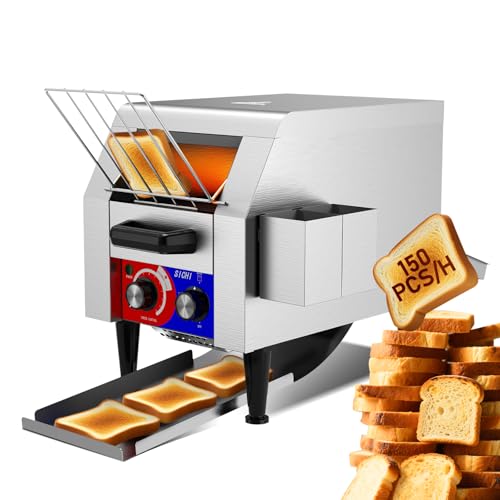
- 7-inch conveyor suits bagel halves
- 3-inch opening accommodates larger products
- Front/rear dispensing and standby mode
Best For: Moderate-volume cafés serving varied breads
Easy-Clean Workhorse

- Produces up to 300 slices per hour
- Seven levels and three baking modes
- Removable crumb tray with front/rear output
Best For: Commercial kitchens prioritizing easy cleanup
Best for Easy Setup
Anatole 400-Slice Conveyor Toaster
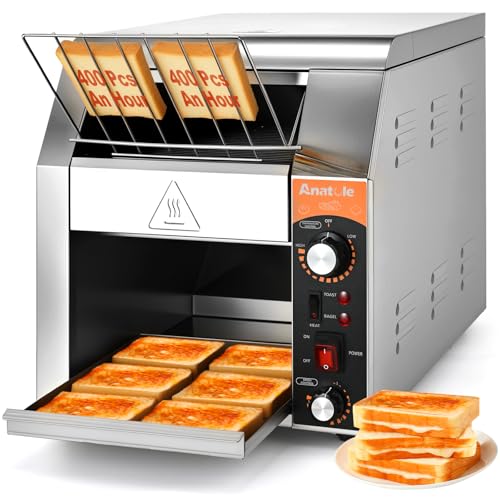
- Up to 400 slices per hour
- Adjustable speed and temperature controls
- Stainless steel with removable crumb tray
Best For: Busy restaurants, buffets, cafés, and hotels
Maximum Throughput
PYY 450-Slice Conveyor Toaster

- Up to 450 slices per hour
- Seven speeds with independent heat control
- Front or rear bread discharge
Best For: High-volume commercial kitchens and cafeterias
Flexible Workflow Choice
300-Slice Wide-Slot Conveyor Toaster

- 10.1-inch opening handles up to three slices
- Seven browning colors and three operating modes
- Front or rear dispensing with crumb tray
Best For: Cafés, buffets, and restaurants with varied bread formats
Best with Extra Features
PYY 300-Slice Commercial Conveyor Toaster

- Up to 300 slices per hour
- Front or rear output modes
- Seven speed and heating options
Best For: Busy restaurants, bakeries, buffets, and cafeterias
Best Heavy-Duty Pick
VEVOR 450-Slice Conveyor Toaster

- Up to 450 slices per hour
- 304 stainless-steel conveyor belt
- Seven browning and three heating modes
Best For: Very busy commercial kitchens and breakfast operations
Compact Capacity Pick
PYY 150-Slice Commercial Conveyor Toaster

- Rated for 150 slices per hour
- Front or rear output options
- Seven adjustable settings
Best For: Moderate-volume cafés, restaurants, offices, and hotels
High-Volume Pick – 450-Slice Commercial Conveyor Toaster
For businesses needing a high-output commercial toaster oven for bagels, this 2,400-watt conveyor model is built around speed, adjustable browning, and flexible output. It can process up to 450 bread pieces per hour, with seven speed settings and selectable upper-and-lower, upper-only, or lower-only heating.
Best For: Bakeries, restaurants, cafés, and other busy food-service settings that need high throughput and front-or-rear product dispensing.
Pros:
- Rated for up to 450 pieces per hour with 2,400 watts of power.
- Seven speed levels and three heating modes support different breads and crispness preferences.
- Dual chutes allow output from the front, rear, or both directions.
- 304 stainless steel construction and ventilation openings support commercial use and heat dissipation.
Cons:
- At 56 pounds, it is relatively heavy to reposition.
- Its 18.3-inch depth and 16.41-inch height require substantial counter space.
This is the strongest capacity-focused choice in the group. Its conveyor design and broad control range suit sustained service, though buyers should measure their workspace and plan for the larger footprint.
Balanced Restaurant Choice – 300-Slice Commercial Toaster
This 1,900-watt conveyor unit offers a practical middle ground for anyone shopping for a commercial toaster oven for bagels. It handles approximately 300 slices per hour and combines seven heating levels with three modes for bread, buns, and other menu items.
Best For: Restaurants, bakeries, cafés, hotels, schools, buffets, and larger households seeking continuous toasting with straightforward controls.
Pros:
- Approximately 300 slices per hour supports continuous service.
- Seven browning levels and three baking modes provide useful flexibility.
- Can toast bread, bagels, donuts, French bread, and buns.
- Removable crumb tray, ventilation holes, and non-slip feet simplify routine operation.
Cons:
- The manufacturer recommends a 10–12 minute preheat and testing with one or two slices.
- Its 12.3-inch depth and 8.1-inch width still require dedicated counter space.
With a moderate 300-slice capacity and clearly defined operating modes, this model is a versatile fit for many commercial kitchens. The preheat requirement is worth factoring into morning setup and service planning.
Wide-Slot Specialist – 150-Slice Bagel Conveyor Toaster
This wide-conveyor model is a useful commercial toaster oven for bagels when accommodating bagel halves, Texas toast, and other larger products matters more than maximum throughput. Its 7-inch conveyor and 3-inch opening are designed for up to 150 slices or bagel halves per hour.
Best For: Cafés, buffets, coffee shops, and commercial kitchens serving varied bread products at moderate volume.
Pros:
- 7-inch-wide conveyor accommodates bagel halves and larger bread products.
- Produces up to 150 slices or bagel halves per hour.
- Front or rear dispensing can support different counter layouts and workflows.
- Standby mode reduces element power between meal periods while shortening warm-up time.
Cons:
- Its 150-slice-per-hour capacity is lower than the other conveyor models here.
- At 21 inches deep and 22 inches high, it has a notably large footprint.
- The notes list one setting, so it offers less stated control detail than seven-level models.
The main reason to choose this toaster is its wide product opening and bagel-friendly conveyor. It makes sense for operators who prioritize accommodating larger items and flexible placement over peak output.
Easy-Clean Workhorse – 300-Slice Conveyor Toaster
For a straightforward commercial toaster oven for bagels, this 1,900-watt conveyor toaster combines 300-slice-per-hour output with seven heating levels and three baking modes. Its stainless steel construction, removable crumb tray, and front/rear output make it suited to regular restaurant and cafeteria service.
Best For: Restaurants, bakeries, hotels, schools, cafeterias, and large-family kitchens that need continuous toasting and easy crumb cleanup.
Pros:
- Rated for 300 slices per hour with 1,900 watts of power.
- Seven heating levels and BREAD, BUNS, and STBY modes support different uses.
- Front and rear chutes allow flexible product removal.
- Pull-out crumb tray, ventilation, and food-grade 304 stainless steel chain support practical operation.
Cons:
- Its 20.5-inch depth may be challenging on compact counters.
- The notes identify analog controls and do not specify a digital display.
This model offers a solid combination of commercial capacity and maintenance-friendly features. It is particularly appealing when removable crumb collection and flexible output are priorities, provided the deeper footprint fits the workspace.
Best for Easy Setup – Anatole 400-Slice Conveyor Toaster
If you need a commercial toaster oven for bagels in a busy buffet, café, or restaurant, the Anatole ATS-360 emphasizes steady output and adjustable browning. Its conveyor design can handle up to 400 slices per hour, while separate temperature and speed controls help tune results for different breads and bagels.
Best For: Restaurants, buffets, hotels, bakeries, cafés, and large households that need high-volume continuous toasting.
Pros:
- Produces up to 400 slices per hour with a 1700W heating system.
- Adjustable conveyor speed and temperature support different browning levels.
- Stainless-steel construction and removable crumb and bread trays simplify commercial use and cleanup.
Cons:
- Its 110V commercial design and countertop footprint may require dedicated placement.
- It is a conveyor toaster rather than a conventional small-slot toaster oven.
The Anatole is a practical choice when throughput matters more than compact, occasional use. Its removable trays and broad food compatibility make it well suited to service environments that regularly toast bread, buns, waffles, and bagels.
Maximum Throughput – PYY 450-Slice Conveyor Toaster
For operations seeking a commercial toaster oven for bagels with continuous production, the PYY 450-01 offers a rated output of up to 450 slices per hour. Seven speed settings, independent heating control, and front or rear discharge let you adapt the unit to different products and countertop layouts.
Best For: High-demand restaurants, bakeries, hotels, schools, cafeterias, and other food-service operations with sustained breakfast volume.
Pros:
- Rated for up to 450 toasted slices per hour.
- Seven speed settings and independent heat control allow more precise browning adjustments.
- Switchable front or rear discharge supports flexible workflow and installation.
- Heavy-duty stainless steel body, ventilation openings, rubber feet, and removable crumb tray support daily commercial use.
Cons:
- At 41.9 pounds, it is relatively heavy to reposition.
- The listed 100V power specification should be checked against the intended kitchen circuit.
- Its approximately 17.32-inch-wide by 20.08-inch-high profile needs substantial counter space.
The PYY stands out for maximum listed capacity and layout flexibility. It is especially compelling where uninterrupted conveyor service and adjustable settings are more important than a small footprint.
Flexible Workflow Choice – 300-Slice Wide-Slot Conveyor Toaster
This wide-slot conveyor model is a useful commercial toaster oven for bagels when you want batch capacity and flexible product handling. Its 10.1-inch opening accepts up to three standard slices, while the 3-inch opening accommodates items such as bagels and Texas toast. The front-or-back dispensing design can also suit different service layouts.
Best For: Cafés, buffets, coffee shops, and restaurants that need versatile conveyor toasting with front or pass-through rear dispensing.
Pros:
- Handles up to 300 slices per hour and fits up to three standard slices at once.
- Two-knob operation provides seven bread-color choices and three modes: BREAD, BUNS, and STBY.
- Front or rear product dispensing supports different counter and workflow configurations.
- Stainless-steel housing, crumb tray, non-slip feet, and UL certification add practical service features.
Cons:
- Its 1770W output and 110V operating requirement should be matched to the available circuit.
- With a rated capacity of 300 slices per hour, it is lower-output than the 400- and 450-slice models here.
The wide opening and selectable discharge make this model a strong middle-ground option. Choose it when your menu includes varied bread sizes and your kitchen benefits from front-service or pass-through operation.
Best with Extra Features – PYY 300-Slice Commercial Conveyor Toaster
If you need a commercial toaster oven for bagels in a busy breakfast operation, this PYY conveyor model is designed for continuous countertop service. It is rated for up to 300 slices per hour and offers seven speed and heating options for adjusting toast results.
Best For: Restaurants, bakeries, buffets, cafeterias, hotels, offices, and other settings serving bagels or toast to larger groups.
Pros:
- Produces up to 300 slices per hour for high-volume service.
- Supports front or rear output to suit different counter layouts.
- Seven settings help adjust conveyor speed and heating mode.
- Stainless-steel construction and a removable crumb tray simplify routine upkeep.
Cons:
- Its 41.6-pound weight and roughly 21.45-by-18.7-by-17.12-inch footprint require substantial counter space.
- The 1,900-watt design may be more capacity than a lower-volume operation needs.
Choose this model when throughput and flexible output direction matter more than a compact footprint. Its bagel-capable design and adjustable controls make it a practical fit for demanding breakfast service.
Best Heavy-Duty Pick – VEVOR 450-Slice Conveyor Toaster
For operations that need a commercial toaster oven for bagels with especially high output, the VEVOR TT-450 is rated for up to 450 slices per hour. Its dual-knob controls let you adjust browning and choose among three heating modes, including independent top and bottom heating.
Best For: High-demand restaurants, bakeries, dessert shops, hotels, buffets, schools, and large breakfast services.
Pros:
- Rated for 450 slices per hour for very high-volume production.
- Food-grade 304 stainless-steel conveyor belt supports smooth bread transport.
- Seven browning settings and three heating modes provide control over results.
- Pull-out crumb tray and smooth stainless-steel surfaces make cleaning easier.
Cons:
- The approximately 28.9-inch depth requires a particularly deep counter.
- At 1,770 watts and 35.9 pounds, it is built for commercial workloads rather than occasional home use.
- The supplied details list bread as the specific use, so bagel-focused buyers should confirm their preferred bagel setup.
This is the strongest capacity choice of the three for continuous service. Its separate browning and heating controls are useful when an operation needs repeatable toast levels across a heavy breakfast rush.
Compact Capacity Pick – PYY 150-Slice Commercial Conveyor Toaster
This PYY model is a practical commercial toaster oven for bagels when you want conveyor-style service without the larger capacity of a 300- or 450-slice unit. It handles up to 150 slices per hour, includes seven settings, and can direct finished items toward the front or rear.
Best For: Smaller restaurants, cafés, offices, hotels, schools, and moderate-volume breakfast counters.
Pros:
- 150-slice-per-hour capacity suits moderate commercial demand.
- Front and rear output modes offer flexible placement on the counter.
- Seven speed and heating options allow adjustment of browning levels.
- Removable crumb tray and stainless-steel construction support easier maintenance.
Cons:
- Its 150-slice-per-hour capacity may be limiting during heavy service.
- The 1,900-watt specification is relatively substantial for its lower throughput rating.
- It still weighs 37 pounds and needs about 20.87 by 14.96 by 16.14 inches of counter space.
Consider this version when your operation needs dependable conveyor toasting but does not require maximum production. It offers the same useful output-direction flexibility and seven-setting control in a smaller format than the 300-slice model.
How We Picked the Best Commercial Toaster Oven for Bagels
We compared the listed commercial toaster ovens for bagels by stated throughput, power, opening dimensions, conveyor configuration, material, and intended foodservice use. Capacity figures are manufacturer claims and can vary with bread size, loading frequency, temperature settings, and whether products are toasted on one or both sides.
We also considered practical differences between compact and high-output designs. A smaller unit can be easier to place behind a counter, while a wider opening or faster conveyor may be more useful for bagels, buns, and bread during peak service.
Quick Comparison
| Best For | What to Look For | Relevant Options |
|---|---|---|
| Lower-volume cafés | About 150 slices per hour, compact footprint | 150-slice-per-hour models |
| Busy cafés and restaurants | About 300 slices per hour, moderate power | 300-slice-per-hour models |
| High-volume breakfast service | 400–450 slices per hour, wider or faster conveyor | 400- and 450-slice-per-hour models |
| Mixed bagel and bun menus | Wide opening and adjustable speed | Wide-slot and seven-speed models |
Key Buying Factors for a Commercial Toaster Oven for Bagels
Throughput and Recovery
Choose capacity based on your busiest 15-minute period rather than average daily volume. A unit rated at 300 to 450 slices per hour provides more headroom, but it may use more power and occupy more counter space. For a smaller café, a 150-slice-per-hour machine may be sufficient and easier to manage.
Opening Width and Product Fit
Bagels, thick buns, and oversized bread need adequate clearance. Check both the opening width and height, and confirm whether the design supports the product orientation your staff uses. Wider openings can improve flexibility, but they may also increase heat loss.
Speed and Browning Control
Adjustable conveyor speed is valuable when switching between bagels, bread, buns, and English muffins. Slower settings generally allow more browning time, while faster settings help maintain output. Temperature controls and independent heat adjustment can provide additional consistency.
Construction, Cleaning, and Power
Stainless-steel construction is appropriate for commercial kitchens because it is durable and relatively easy to wipe down. Look for removable crumb trays, accessible conveyor areas, and guards that simplify daily cleaning. Before ordering, verify the wattage, voltage, plug, circuit requirements, clearance, and ventilation needs with your facility.
Who Should Buy Which Commercial Toaster Oven for Bagels?
Choose a 150-slice-per-hour model for a coffee shop, kiosk, or light breakfast operation with limited counter space. Choose a 300-slice-per-hour model for a restaurant or café serving steady bagel and toast orders throughout the morning. Choose a 400- to 450-slice-per-hour model for hotels, cafeterias, catering operations, and high-volume breakfast lines where queue speed matters most.
If your menu includes large bagels or buns, prioritize a wide-opening design over headline capacity alone. If consistency across changing products is the priority, favor adjustable speed and clear controls. Finally, confirm the machine’s electrical and physical requirements before purchase so the selected Commercial Toaster Oven for Bagels fits both your workflow and your kitchen infrastructure.